
 Media Stream Solutions
 Gaming Solutions
 E-Commerce Solutions
 VPN Server Solutions
 GPU Server Solutions
 Financial Solutions
 Security Solutions
Quick Summary / Key Takeaways
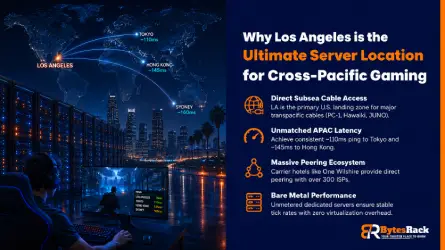
- Direct Subsea Cable Access: LA is the primary U.S. landing zone for major transpacific cables (PC-1, Hawaiki, JUNO), skipping inland routing hops entirely.
- Unmatched APAC Latency: Achieve consistent ~110ms ping to Tokyo and ~145ms to Hong Kong, bridging U.S. West Coast and Asian player bases on a single server.
- Massive Peering Ecosystem: Carrier hotels like One Wilshire provide direct peering with over 300 ISPs, slashing jitter and packet loss.
- Bare Metal Performance: Unmetered dedicated servers in LA prevent the resource starvation and variable latency common in virtualized cloud environments.
When deploying multiplayer infrastructure, physical geography dictates network performance long before your code executes. You cannot defeat the speed of light, but you can engineer the shortest possible fiber path between your users.
For game studios aiming to unify North American and Asia-Pacific (APAC) player bases, choosing the correct datacenter location is a critical architectural decision. Los Angeles stands completely unmatched as the premier U.S. gateway for transpacific gaming traffic.
Network Architecture & Peering
The Transpacific Subsea Cable Advantage
Network latency is a direct product of physical distance and routing complexity. Servers located in the central U.S. or East Coast must traverse terrestrial fiber across the continent before even beginning their ocean crossing. This adds 50 to 80 milliseconds of baseline latency, introducing multiple points of potential packet loss along the way.
By contrast, Los Angeles sits directly on the coastline where massive submarine networks terminate. Systems like the PC-1, Hawaiki, and the upcoming JUNO cable land locally or route directly into LA carrier hotels. Deploying your dedicated game server here means player traffic enters the transpacific backbone almost instantly. This direct onboarding drastically minimizes network hops, stabilizing the tick rate for competitive multiplayer environments.
Carrier Density and The One Wilshire Ecosystem
Proximity to the ocean is only half the equation; your server also needs elite domestic and international routing. Downtown Los Angeles houses some of the most concentrated internet interconnection hubs on the planet, most notably One Wilshire. Over 300 carriers, Internet Service Providers (ISPs), and content delivery networks peer directly within this ecosystem.
For game servers, dense peering is a massive competitive advantage. When your infrastructure sits in the same facility as Tier-1 providers (like NTT, Lumen, and China Unicom), player traffic does not have to route through congested public transit. BGP routing algorithms can immediately hand off data to the fastest available carrier. This eliminates the dreaded lag spikes and jitter that ruin real-time gameplay.
Latency & Bare Metal Performance
The Latency Math: LA to APAC Ping Times
To understand the LA advantage, we must look at hard latency metrics. A dedicated server in Los Angeles routinely achieves sub-10ms latency for players across the U.S. West Coast. However, the true value emerges when evaluating the Asia-Pacific ping numbers.
From Los Angeles, you can reliably expect ~110ms to Tokyo, ~145ms to Hong Kong, and ~160ms to Sydney. Compare this to an East Coast server in New York, which typically suffers 190ms to 220ms when reaching Tokyo. In modern gaming, especially first-person shooters and fighting games, that 80ms reduction is the difference between smooth netcode and an unplayable experience.
Why Dedicated Hardware Beats VPS for Multiplayer
Network location is irrelevant if the underlying server hardware cannot process the simulation frame rate. Virtual Private Servers (VPS) utilize hypervisors to split hardware among multiple tenants, causing resource contention. When a "noisy neighbor" on the same hypervisor spikes their CPU usage, your game server experiences immediate tick rate drops.
Bare metal dedicated servers isolate your workload completely. You maintain 100% control over the CPU cores, RAM, and PCIe lanes, ensuring zero virtualization overhead. Furthermore, multiplayer games generate massive, continuous outbound traffic. Utilizing unmetered 1Gbps or 10Gbps uplinks in LA ensures you never hit data caps or face unexpected bandwidth overages.
Architect Your Gaming Infrastructure with BytesRack
Cross-Pacific latency does not have to be a bottleneck for your player base. Deploying bare metal hardware at the internet's most strategic geographic points is the fastest way to stabilize your multiplayer netcode.
At BytesRack, we provide enterprise-grade, unmetered dedicated servers hosted directly in Los Angeles. Benefit from our premium Tier-1 routing, elite DDoS protection, and immediate hardware provisioning.
Deploy Your Los Angeles Server TodayFAQ: Los Angeles Dedicated Servers
-
Why should I choose Los Angeles over Seattle for a gaming server?
-
Can players from Japan and California play on the same LA server without lag?
-
What is the benefit of unmetered bandwidth for game servers?
-
How does BGP routing improve game server performance?
Recent Topics for you
Why Your Custom CDN Origin Belongs on Bare Metal (And How to Escape Cloud Egress Fees)
Discover why moving your custom CDN origin to bare metal eliminates cloud egress fees, boosts NVMe I/O performance, and prevents unpredictable billing.

GPU vs CPU Dedicated Servers for AI Inference: Which Do You Actually Need?
Discover whether your AI inference workloads need a GPU or CPU dedicated server. Compare VRAM, TTFT, costs, and performance for 8B to 70B+ LLMs.

The GPU Sizing Guide for AI Agent Workloads on Dedicated Servers
Learn how to calculate exact GPU VRAM requirements for AI agents. Understand quantization, KV cache sizing, and choose the right dedicated server.
Why Los Angeles is the Ultimate Server Location for Cross-Pacific Gaming
Discover why Los Angeles dedicated servers provide unmatched transpacific low latency for gaming. Bridge US and APAC players with Tier-1 routing.

The London Advantage: Why UK Dedicated Servers are Vital
Discover why London dedicated servers are essential for global finance and tech. Explore ultra-low latency, UK GDPR compliance, and Tier-1 network benefits.

Ransomware Defense in 2026
Prevent ransomware in 2026 with isolated dedicated servers. Learn why bare-metal and immutable backups beat cloud storage for enterprise data security.

The Rise of Geo-Targeted Dedicated Servers for IoT
Explore why global enterprises are shifting to geo-targeted dedicated servers to eliminate latency, ensure data sovereignty, and power real-time industrial processing

Why Massive E-Commerce Stores Need Dedicated Servers
Find out why massive e-commerce stores need dedicated servers to scale. BytesRack explains how bare-metal stops downtime, cuts cloud fees, and boosts speed.

Why Low Latency Dedicated Servers Are Faster Than Your Workstation
Discover why professional studios are moving 4K/8K video editing to low-latency dedicated servers in 2026 to bypass hardware bottlenecks and thermal throttling.

The Rise of AI-Powered DDoS in 2026
AI-powered DDoS attacks are evolving faster than legacy firewalls can adapt. Discover why standard hosting is failing in 2026 and how enterprise-grade, unmetered DDoS dedicated servers can keep your infrastructure online.

Why Your Server Location Matters: The Singapore Advantage for APAC Speed and SEO
Need to serve the APAC region? A Singapore server location provides the lowest latency. Learn how proximity boosts your site speed, Core Web Vitals, and SEO rankings.

Why MCP Servers Belong on Dedicated Hardware?
Discover why Model Context Protocol (MCP) nodes require dedicated hardware to avoid the 2-second Cold Start bottleneck of serverless functions.
Docmost Instead of Notion:How to Cut Your Costs by 90% in 2026
Stop renting your data. Discover why companies switch to self-hosted Docmost and Outline Wiki on BytesRack dedicated servers to save 90% and regain privacy..

Cloud GPU vs. Dedicated GPU Server
In 2026, the smart move for AI startups and high-performance gaming communities isn't the Cloud; it's Dedicated GPU Servers.

Power Your Business with a Toronto Dedicated Server
Learn how Toronto's unique submarine cable gives our dedicated servers a speed advantage for serving Canada and the US.
The Miami Advantage:Why Your Dedicated Server Belongs at the Gateway to the Americas
Discover why a Miami dedicated server is your secret weapon. Get unrivaled low latency to Latin America & the US. Unlock strategic growth today.
Why Your Business Needs a Tokyo Dedicated Server from BytesRack
This guide will explore why Tokyo is the undisputed strategic hub for APAC and how BytesRack's dedicated servers provide the power, performance, and reliability you need to dominate the market.
Gain the Ultimate Edge: The Power of a New York Dedicated Server
Discover why New York offers the ultimate hosting advantage. Unrivaled connectivity to US & European markets

Why Germany Is the Best Location for Your Next Dedicated Server?
Discover why Germany offers the best hosting. GDPR compliance, ultra-low latency via DE-CIX Frankfurt, and enterprise-grade reliability.

Which Web Hosting Control Panel Should You Use?cPanel or Plesk
In this blog, we’ll break down the differences between cPanel and Plesk, helping you decide which control panel suits your hosting environment and technical needs best.

How to Restore SQL Server Databases Using SSMS
Learn how to restore MSSQL databases using SQL Server Management Studio (SSMS) with expert tips and best practices.

The Ultimate Guide to Dedicated Servers for Streaming - 2025
Boost performance, reduce buffering, and scale with confidence. These expert tips help you optimize your dedicated streaming server for speed, security, and seamless viewer experience.