
 Media Stream Solutions
 Gaming Solutions
 E-Commerce Solutions
 VPN Server Solutions
 GPU Server Solutions
 Financial Solutions
 Security Solutions
The Executive Summary
- Multi-Stage Extortion is the Standard: Ransomware in 2026 targets backups first. If your backups are compromised, you lose your leverage.
- Shared Infrastructure Increases Risk: Public cloud environments introduce vulnerabilities via shared hypervisors, complex IAM misconfigurations, and lateral movement risks.
- Physical Isolation is Paramount: Dedicated servers provide 100% tenant isolation, eliminating the "noisy or infected neighbor" threat entirely.
- Immutable Vaults Ensure Recovery: Architecting a secondary, completely isolated bare-metal server for WORM (Write Once, Read Many) backups guarantees data recovery without paying unpredictable cloud egress fees.
The modern ransomware landscape has fundamentally shifted. In 2026, ransomware operators no longer rely solely on encrypting active databases. Instead, cybercriminal syndicates utilize highly coordinated, multi-stage extortion tactics. They infiltrate networks, exfiltrate sensitive data, actively hunt down and delete backup repositories, and threaten public release if demands are not met.
For scaling enterprises, standard shared infrastructure and default public cloud security are proving insufficient against these sophisticated attacks. To survive and maintain absolute data sovereignty, cloud infrastructure architects are aggressively pivoting toward a more isolated foundation: Bare-Metal Dedicated Servers.
This guide breaks down the architectural vulnerabilities of shared hosting and explores how deploying isolated hardware with immutable storage is your strongest defense mechanism.
The Architectural Flaws of Public Cloud Security
The elasticity of the public cloud is undeniable, but it inherently relies on multi-tenancy. Your enterprise data sits on the same physical hardware—and often routes through the same virtualized network switches—as hundreds of other organizations.
Lateral Movement and Shared Hypervisors
In a shared environment, an infection in one virtual machine can potentially exploit hypervisor vulnerabilities (VM escapes) to access the underlying host or adjacent networks. Furthermore, the complexity of public cloud Identity and Access Management (IAM) often leads to misconfigurations. A single compromised IAM credential can give attackers administrative access to your primary instances and your cloud storage buckets simultaneously.
The Hidden Cost of Disaster Recovery
If your primary cloud instances are locked down and you need to restore terabytes of data from a public cloud storage bucket (like S3), you are entirely at the mercy of their network throughput limits. Worse, you will be hit with massive egress fees just to download your own data to rebuild your infrastructure, adding a massive financial penalty to an already critical situation.
The Bare-Metal Advantage: Hardware-Level Isolation
A dedicated server provides absolute physical isolation. This architecture inherently mitigates the risks associated with multi-tenant environments.
100% Resource and Network Isolation
When you provision a dedicated server, you are not sharing a hypervisor, RAM, or a network interface with anyone else. The risk of lateral ransomware infection from an insecure neighbor drops to absolute zero.
Granular Security Control
With full bare-metal access, infrastructure engineers control the entire stack. You deploy your own hypervisor (such as Proxmox or VMware), define your exact OS kernel parameters, and implement Zero-Trust Network Access (ZTNA). You are not constrained by the limitations of a cloud provider’s default firewall.
How BytesRack Secures Your Workloads
When architecting a ransomware-resilient environment, the underlying hardware reliability is critical. Deploying your infrastructure on BytesRack dedicated servers ensures you are backed by enterprise-grade hardware and unmetered DDoS protection. By leveraging BytesRack's highly secure global data centers, enterprises gain the unmetered, high-speed bandwidth necessary to restore terabytes of data in minutes—bypassing the bandwidth throttling and exorbitant data transfer fees common in public cloud recovery scenarios.
Building the Ultimate Defense: The Immutable Backup Vault
Hackers know that if you have functional backups, their extortion attempts will fail. Therefore, the core of your 2026 ransomware defense must be an Immutable Backup strategy.
An immutable backup uses a WORM (Write Once, Read Many) architecture. Once data is written to the drive, it cannot be modified, encrypted, or deleted by a rogue script, a compromised root account, or even the system administrator until a predefined time limit expires.
The most secure architectural approach is to provision a Secondary Dedicated Server completely isolated from your primary application environment.
Network Isolation for Backup Vaults
Your backup server should only accept incoming connections from your primary server on specific ports, dropping all other traffic. Here is a baseline example of how to configure UFW (Uncomplicated Firewall) on your secondary Ubuntu backup vault to only allow incoming backup traffic (e.g., port 9000 for MinIO) from your primary server's IP address:
# Reset UFW to default deny state
sudo ufw default deny incoming
sudo ufw default allow outgoing

# Allow SSH only from your secure management IP (Admin VPN)
sudo ufw allow from <YOUR_VPN_IP> to any port 22

# Allow Backup API traffic ONLY from the Primary Web/DB Server IP
sudo ufw allow from <PRIMARY_SERVER_IP> to any port 9000

# Enable the firewall
sudo ufw enable
sudo ufw status verbose
By coupling strict network isolation with Object Lock compliance, you create a digital fortress.
Architecting the Vault: If you are ready to implement this defense, read our comprehensive technical guide on How to Configure Immutable Backups on a Dedicated Server to learn how to deploy Docker, MinIO, and Restic for a self-hosted, ransomware-proof solution.
Ransomware syndicates will continue to exploit shared environments and weak backup strategies. Protecting your enterprise in 2026 requires moving away from the vulnerabilities of multi-tenancy and embracing the control, isolation, and raw performance of physical hardware. By pairing an isolated application server with a secondary, immutable bare-metal backup vault, you effectively neutralize the threat of data extortion.
Take full control of your infrastructure's security posture. Scale with confidence, eliminate cloud egress fees, and protect your critical assets by exploring BytesRack Dedicated Servers today.
Explore Dedicated ServersFAQ: Ransomware Defense on Bare-Metal
-
Does deploying a dedicated server automatically protect my data from ransomware?
-
Why shouldn't I just use public S3 storage for my immutable backups?
-
What is the recommended Recovery Time Objective (RTO) against ransomware in 2026?
Recent Topics for you

GPU vs CPU Dedicated Servers for AI Inference: Which Do You Actually Need?
Discover whether your AI inference workloads need a GPU or CPU dedicated server. Compare VRAM, TTFT, costs, and performance for 8B to 70B+ LLMs.

The GPU Sizing Guide for AI Agent Workloads on Dedicated Servers
Learn how to calculate exact GPU VRAM requirements for AI agents. Understand quantization, KV cache sizing, and choose the right dedicated server.

Why Los Angeles is the Ultimate Server Location for Cross-Pacific Gaming
Discover why Los Angeles dedicated servers provide unmatched transpacific low latency for gaming. Bridge US and APAC players with Tier-1 routing.

The London Advantage: Why UK Dedicated Servers are Vital
Discover why London dedicated servers are essential for global finance and tech. Explore ultra-low latency, UK GDPR compliance, and Tier-1 network benefits.
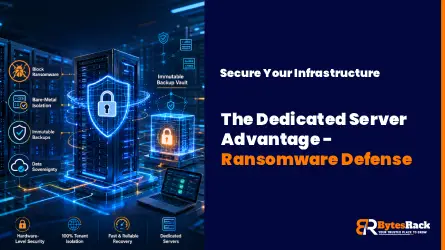
Ransomware Defense in 2026
Prevent ransomware in 2026 with isolated dedicated servers. Learn why bare-metal and immutable backups beat cloud storage for enterprise data security.

The Rise of Geo-Targeted Dedicated Servers for IoT
Explore why global enterprises are shifting to geo-targeted dedicated servers to eliminate latency, ensure data sovereignty, and power real-time industrial processing

Why Massive E-Commerce Stores Need Dedicated Servers
Find out why massive e-commerce stores need dedicated servers to scale. BytesRack explains how bare-metal stops downtime, cuts cloud fees, and boosts speed.

Why Low Latency Dedicated Servers Are Faster Than Your Workstation
Discover why professional studios are moving 4K/8K video editing to low-latency dedicated servers in 2026 to bypass hardware bottlenecks and thermal throttling.

The Rise of AI-Powered DDoS in 2026
AI-powered DDoS attacks are evolving faster than legacy firewalls can adapt. Discover why standard hosting is failing in 2026 and how enterprise-grade, unmetered DDoS dedicated servers can keep your infrastructure online.

Why Your Server Location Matters: The Singapore Advantage for APAC Speed and SEO
Need to serve the APAC region? A Singapore server location provides the lowest latency. Learn how proximity boosts your site speed, Core Web Vitals, and SEO rankings.

Why MCP Servers Belong on Dedicated Hardware?
Discover why Model Context Protocol (MCP) nodes require dedicated hardware to avoid the 2-second Cold Start bottleneck of serverless functions.
Docmost Instead of Notion:How to Cut Your Costs by 90% in 2026
Stop renting your data. Discover why companies switch to self-hosted Docmost and Outline Wiki on BytesRack dedicated servers to save 90% and regain privacy..
Cloud GPU vs. Dedicated GPU Server
In 2026, the smart move for AI startups and high-performance gaming communities isn't the Cloud; it's Dedicated GPU Servers.

Power Your Business with a Toronto Dedicated Server
Learn how Toronto's unique submarine cable gives our dedicated servers a speed advantage for serving Canada and the US.
The Miami Advantage:Why Your Dedicated Server Belongs at the Gateway to the Americas
Discover why a Miami dedicated server is your secret weapon. Get unrivaled low latency to Latin America & the US. Unlock strategic growth today.
Why Your Business Needs a Tokyo Dedicated Server from BytesRack
This guide will explore why Tokyo is the undisputed strategic hub for APAC and how BytesRack's dedicated servers provide the power, performance, and reliability you need to dominate the market.
Gain the Ultimate Edge: The Power of a New York Dedicated Server
Discover why New York offers the ultimate hosting advantage. Unrivaled connectivity to US & European markets
Why Germany Is the Best Location for Your Next Dedicated Server?
Discover why Germany offers the best hosting. GDPR compliance, ultra-low latency via DE-CIX Frankfurt, and enterprise-grade reliability.

Which Web Hosting Control Panel Should You Use?cPanel or Plesk
In this blog, we’ll break down the differences between cPanel and Plesk, helping you decide which control panel suits your hosting environment and technical needs best.

How to Restore SQL Server Databases Using SSMS
Learn how to restore MSSQL databases using SQL Server Management Studio (SSMS) with expert tips and best practices.

The Ultimate Guide to Dedicated Servers for Streaming - 2025
Boost performance, reduce buffering, and scale with confidence. These expert tips help you optimize your dedicated streaming server for speed, security, and seamless viewer experience.