
 Media Stream Solutions
 Gaming Solutions
 E-Commerce Solutions
 VPN Server Solutions
 GPU Server Solutions
 Financial Solutions
 Security Solutions
Quick Summary / Key Takeaways
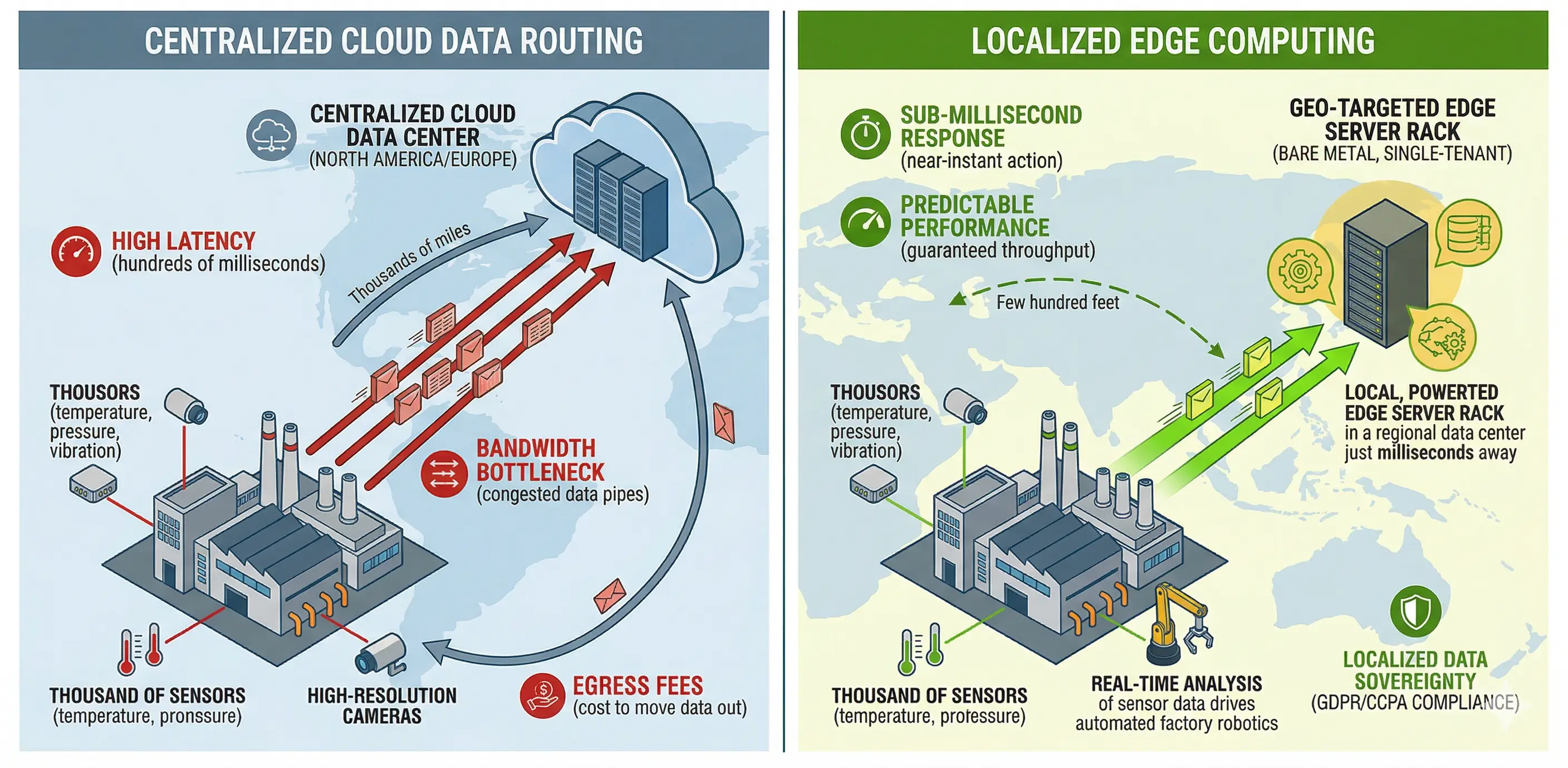
- The Cloud Bottleneck: Centralized cloud infrastructure is no longer sufficient for modern Industrial IoT due to latency, bandwidth bottlenecks, and excessive data egress fees.
- Zero Latency at the Edge: Edge computing shifts processing closer to the data source, reducing response times to sub-milliseconds for critical applications like autonomous manufacturing.
- Maximum Hardware Power: Geo-targeted bare metal servers eliminate the "virtualization tax" of shared cloud environments, providing the predictable, high-speed performance required by continuous sensor data streams.
- Global Data Sovereignty: A massive global edge network allows multinational enterprises to maintain strict regulatory compliance (like GDPR and CCPA) while keeping server power physically close to their worldwide operations.
As we navigate the demands of 2026, the Internet of Things (IoT) has evolved far beyond consumer devices. Today's industrial networks, automated global supply chains, and smart cities deploy billions of interconnected sensors generating terabytes of data daily. Processing this massive volume of information requires a fundamental shift in how enterprise architects design server infrastructure.
Routing every data packet across oceans to a centralized cloud data center is no longer a viable engineering strategy. Modern industrial IoT requires split-second decision-making where even minor network latency can cause severe financial losses or safety hazards. To solve this, enterprise IT leaders are aggressively moving toward edge computing powered by geo-targeted dedicated servers.
This guide explores exactly why bare metal edge infrastructure is replacing standard cloud environments for high-stakes, global IoT deployments.
Why Traditional Cloud Struggles with Next-Gen IoT Demands
Manufacturing plants and logistics hubs generate massive streams of continuous data. A single mid-sized facility running high-resolution quality control cameras and vibration sensors can easily produce several terabytes of data every 24 hours. Pushing all this raw data over the public internet to a centralized cloud platform creates immediate bandwidth congestion.
Furthermore, traditional cloud platforms operate on shared, virtualized environments. This hypervisor layer which manages multiple virtual machines on a single physical server consumes valuable CPU cycles and memory. For basic web hosting, this overhead is negligible, but for high-frequency IoT data ingestion, it introduces unpredictable micro-delays.
Finally, relying solely on centralized cloud providers introduces significant financial and operational risks. Cloud egress fees the cost to move data out of the cloud can become astronomically expensive when dealing with heavy IoT workloads. Additionally, if the primary internet connection to the cloud provider drops, the entire local production line risks coming to a complete halt.
Enter Edge Computing and Geo-Targeted Bare Metal
Edge computing solves the latency problem by processing data at or near the physical location where it is generated. Instead of sending manufacturing data from a facility in Texas all the way to a cloud server in New York—or from a Southeast Asian plant to a European data center—the data is processed locally. This localized processing enables ultra-low latency, ensuring autonomous systems can react to real-time events in milliseconds.
To achieve this, infrastructure architects deploy geo-targeted dedicated servers. These are single-tenant, bare metal machines strategically located in regional data centers closest to the industrial operation. Because they are dedicated exclusively to one organization, they provide 100% of their compute power without competing against noisy neighbors on the same network.
Bypassing the Virtualization Tax
Traditional cloud platforms operate on shared, virtualized environments. This hypervisor layer—which manages multiple virtual machines on a single physical server—consumes valuable CPU cycles and memory. For basic web hosting, this overhead is negligible, but for high-frequency IoT data ingestion, it introduces unpredictable micro-delays.
Bare metal servers eliminate the hypervisor virtualization layer entirely. Applications communicate directly with the server hardware, ensuring maximum utilization of the CPU and memory resources. This direct hardware access provides the sustained, predictable performance required to run complex machine learning models and real-time analytics without stuttering.
Strategic Advantages of a Massive Global Edge Network
For multinational organizations, server location is about more than just speed—it is the backbone of global operational security. When your headquarters is in London or New York, but your manufacturing plants are distributed across Asia, Latin America, or Eastern Europe, relying on a centralized cloud creates massive routing bottlenecks.
This is why modern enterprise architects demand a hyper-local edge presence on a global scale. By partnering with an infrastructure provider that operates over 250 globally distributed edge locations, businesses guarantee sub-millisecond network routing regardless of where their operations are physically based. Whether you are managing an automotive plant in Germany, a logistics hub in Texas, or a smart-manufacturing facility in Singapore, a massive geo-targeted network ensures a bare metal server is always positioned in the immediate vicinity of your sensors.
Global Data Sovereignty and Borderless Compliance
As enterprises expand internationally, they encounter a complex web of regional data protection laws. Regulatory frameworks like the GDPR in Europe and the CCPA in California set the global standard for how sensitive data must be handled. Processing industrial or consumer data outside of specific geographic boundaries can result in severe legal and financial penalties.
Geo-targeted dedicated servers solve this by providing verifiable physical isolation anywhere in the world. Unlike public cloud services where data might dynamically migrate across international availability zones, a dedicated edge server keeps your data cryptographically and physically locked to a specific geographic coordinate. This empowers your compliance officers to easily prove data sovereignty across your entire global footprint.
Architecting Your IoT Server Infrastructure
Building an edge computing environment requires hardware engineered specifically for high-throughput workloads. Your infrastructure must be designed for maximum resilience and sustained throughput:
- Multi-Core Processing: Concurrent data streams require substantial CPU power. Look for enterprise-grade processors with high core counts that can manage data aggregation while simultaneously running real-time analytics.
- NVMe SSD Storage: Traditional hard drives, and even standard SATA SSDs, cannot keep up with continuous sensor writes. NVMe storage is mandatory to prevent data bottlenecks and ensure instantaneous read/write speeds directly to the motherboard.
- Unmetered, High-Capacity Bandwidth: High-resolution computer vision and machine logs generate heavy network traffic. 1Gbps to 10Gbps dedicated uplink ports are necessary to prevent packet loss and ensure stable data transmission.
Real-World Applications of Edge Infrastructure
The shift to the edge is already transforming global industries. Here are the most common applications of our geo-targeted edge infrastructure:
Predictive Maintenance
Heavy machinery is equipped with vibration and thermal sensors that stream continuous health data. Geo-targeted edge servers process this data locally, using AI to detect micro-anomalies and schedule maintenance before catastrophic equipment failure occurs.
Automated Quality Control
Modern assembly lines use computer vision to inspect products moving at high speeds. Dedicated edge servers analyze these high-resolution images locally, instantly triggering robotic arms to remove defective items without slowing down the production line.
Smart City Traffic Management
Intelligent traffic grids rely on thousands of live camera feeds and vehicle sensors. Processing this data on regional dedicated servers allows cities to dynamically adjust traffic lights in real-time, optimizing traffic flow.
Strategic Edge Presence
By partnering with an infrastructure provider that operates over 250 globally distributed edge locations, businesses guarantee sub-millisecond network routing regardless of where their operations are physically based.
Ready to Architect Your Edge Infrastructure?
Your global IoT deployment cannot afford the latency and unpredictable performance of shared cloud environments. At BytesRack, we engineer premium, high-performance bare metal infrastructure perfectly tailored for heavy, continuous data workloads.
Discover BytesRack's Global IoT Dedicated Server Solutions today and bring unparalleled speed, strict compliance, and absolute security to the edge of your network.
Consult an Edge ArchitectIndustrial IoT and Dedicated Infrastructure FAQs
-
Why are dedicated servers better than public cloud for Industrial IoT?
-
What is the "virtualization tax" in cloud computing?
-
How does geo-targeting ensure GDPR and CCPA compliance?
-
Why is NVMe storage mandatory for IoT edge servers?
Recent Topics for you

Why Your Custom CDN Origin Belongs on Bare Metal (And How to Escape Cloud Egress Fees)
Discover why moving your custom CDN origin to bare metal eliminates cloud egress fees, boosts NVMe I/O performance, and prevents unpredictable billing.

GPU vs CPU Dedicated Servers for AI Inference: Which Do You Actually Need?
Discover whether your AI inference workloads need a GPU or CPU dedicated server. Compare VRAM, TTFT, costs, and performance for 8B to 70B+ LLMs.

The GPU Sizing Guide for AI Agent Workloads on Dedicated Servers
Learn how to calculate exact GPU VRAM requirements for AI agents. Understand quantization, KV cache sizing, and choose the right dedicated server.

Why Los Angeles is the Ultimate Server Location for Cross-Pacific Gaming
Discover why Los Angeles dedicated servers provide unmatched transpacific low latency for gaming. Bridge US and APAC players with Tier-1 routing.

The London Advantage: Why UK Dedicated Servers are Vital
Discover why London dedicated servers are essential for global finance and tech. Explore ultra-low latency, UK GDPR compliance, and Tier-1 network benefits.
Ransomware Defense in 2026
Prevent ransomware in 2026 with isolated dedicated servers. Learn why bare-metal and immutable backups beat cloud storage for enterprise data security.

The Rise of Geo-Targeted Dedicated Servers for IoT
Explore why global enterprises are shifting to geo-targeted dedicated servers to eliminate latency, ensure data sovereignty, and power real-time industrial processing

Why Massive E-Commerce Stores Need Dedicated Servers
Find out why massive e-commerce stores need dedicated servers to scale. BytesRack explains how bare-metal stops downtime, cuts cloud fees, and boosts speed.
Why Low Latency Dedicated Servers Are Faster Than Your Workstation
Discover why professional studios are moving 4K/8K video editing to low-latency dedicated servers in 2026 to bypass hardware bottlenecks and thermal throttling.

The Rise of AI-Powered DDoS in 2026
AI-powered DDoS attacks are evolving faster than legacy firewalls can adapt. Discover why standard hosting is failing in 2026 and how enterprise-grade, unmetered DDoS dedicated servers can keep your infrastructure online.

Why Your Server Location Matters: The Singapore Advantage for APAC Speed and SEO
Need to serve the APAC region? A Singapore server location provides the lowest latency. Learn how proximity boosts your site speed, Core Web Vitals, and SEO rankings.

Why MCP Servers Belong on Dedicated Hardware?
Discover why Model Context Protocol (MCP) nodes require dedicated hardware to avoid the 2-second Cold Start bottleneck of serverless functions.

Docmost Instead of Notion:How to Cut Your Costs by 90% in 2026
Stop renting your data. Discover why companies switch to self-hosted Docmost and Outline Wiki on BytesRack dedicated servers to save 90% and regain privacy..

Cloud GPU vs. Dedicated GPU Server
In 2026, the smart move for AI startups and high-performance gaming communities isn't the Cloud; it's Dedicated GPU Servers.

Power Your Business with a Toronto Dedicated Server
Learn how Toronto's unique submarine cable gives our dedicated servers a speed advantage for serving Canada and the US.
The Miami Advantage:Why Your Dedicated Server Belongs at the Gateway to the Americas
Discover why a Miami dedicated server is your secret weapon. Get unrivaled low latency to Latin America & the US. Unlock strategic growth today.
Why Your Business Needs a Tokyo Dedicated Server from BytesRack
This guide will explore why Tokyo is the undisputed strategic hub for APAC and how BytesRack's dedicated servers provide the power, performance, and reliability you need to dominate the market.
Gain the Ultimate Edge: The Power of a New York Dedicated Server
Discover why New York offers the ultimate hosting advantage. Unrivaled connectivity to US & European markets

Why Germany Is the Best Location for Your Next Dedicated Server?
Discover why Germany offers the best hosting. GDPR compliance, ultra-low latency via DE-CIX Frankfurt, and enterprise-grade reliability.

Which Web Hosting Control Panel Should You Use?cPanel or Plesk
In this blog, we’ll break down the differences between cPanel and Plesk, helping you decide which control panel suits your hosting environment and technical needs best.

How to Restore SQL Server Databases Using SSMS
Learn how to restore MSSQL databases using SQL Server Management Studio (SSMS) with expert tips and best practices.

The Ultimate Guide to Dedicated Servers for Streaming - 2025
Boost performance, reduce buffering, and scale with confidence. These expert tips help you optimize your dedicated streaming server for speed, security, and seamless viewer experience.